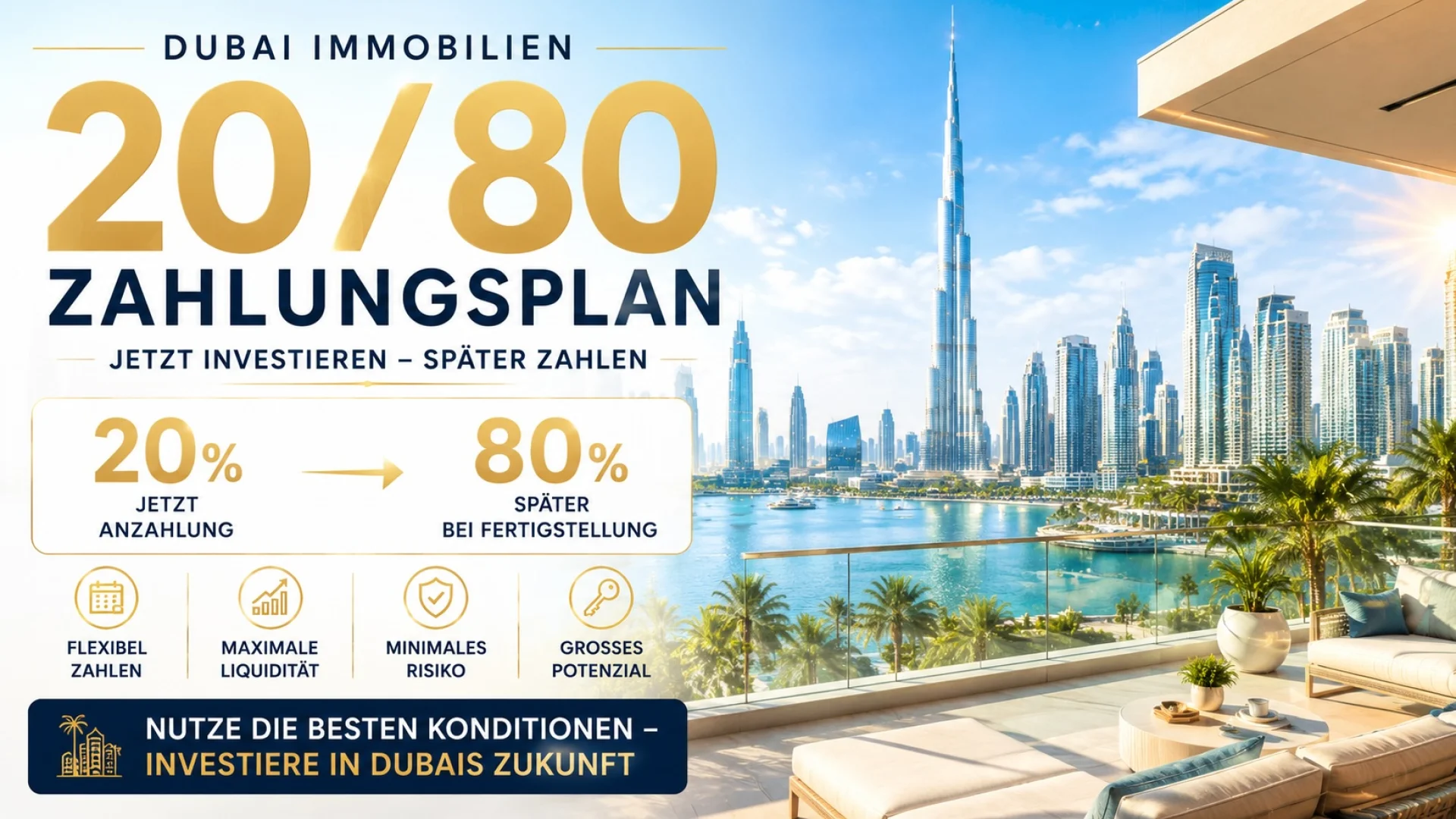
The agent slides a card across the table: 20 now, 80 at handover. The 20/80 payment plan is Dubai’s most charming invitation to enter a new-build property with relatively little upfront capital — and pay the largest share of the purchase price only when the keys are handed over. It sounds simple, and it is. Here is the complete guide, packed with showroom scenarios, checklists and figures to help you make the right decision.
The showroom door opens, and cool air conditioning meets a warm smile. Glass, gold, a sparkling model of the skyline. An advisor taps a pen against a tower that looks as though it could take off at any moment. "Twenty now, eighty at handover," he says, pulling out a small card. It sounds almost like a magic formula. Simple, elegant, almost too good to be true.
Dubai’s 20/80 payment plan – the formula that attracts buyers and investors. Used correctly, it can be a highly attractive route into a new-build property.
What 20/80 really means
The mechanism is simple: During the construction period, you pay around 20% of the purchase price in instalments. The remaining 80% becomes due at handover – either from your own funds or through a mortgage that takes effect once the property is completed. Dubai developers use RERA-regulated escrow accounts for this purpose. Your instalments are deposited into these accounts and released in line with construction progress. Security meets speed.
How it works step by step
Reservation: You choose a property.
Sales and Purchase Agreement: Shortly afterwards, the Sales and Purchase Agreement (SPA) follows.
Down payment: You pay only 20% of the purchase price.
DLD fee: In Dubai, a registration fee of 4% is payable to the Dubai Land Department.
Construction phase: While your new home or investment is being built, you make no further payments – your capital remains liquid and available to you.
Mortgage preparation: Anyone planning to finance the remaining 80% should obtain pre-approval early. Banks generally finance only at handover; the property valuation takes place shortly before completion.
Handover: Quality inspection and acceptance.
Final payment: Only now do you pay the remaining 80% of the purchase price.
Key handover: And finally, the envelope with the keys changes hands.
Costs you should know about
Land registration fees: Standard purchase registration costs (4% of the purchase price in Dubai).
Oqood/registration: Administrative fees for off-plan units (approx. EUR 1,000).
Mortgage: Bank processing fee, valuation and mortgage registration fees, if required.
Broker commission: Die Geissens Real Estate does not charge the customer a brokerage fee.
Service Charges: Annual operating and maintenance costs per square metre.
Handover extras: Connection fees, for example for telephone, electricity, water and air conditioning.
Why 20/80 is so attractive
It is the combination that makes it compelling: a low entry threshold, clear milestones and predictable planning. Anyone placing 20% today secures a price before the building is completed. Those planning to rent can look forward to rental income if the remaining 80% is covered by a mortgage, or even if a post-handover payment plan is available under which 40% of the purchase price is paid in instalments after completion. And those looking to trade can – depending on the contract – resell before handover through an assignment, often at a profit if the market has moved upwards.
The key advantages
Low entry threshold: Start with 20%, pay the balance at handover.
Cashflow-friendly: Your capital remains flexible for longer.
Market opportunity: Potential price appreciation during construction.
Leverage: The remaining 80% can be structured through a mortgage.
Mini case study: The moment it clicks
Jonas, 34, looks out over the Marina at sunset. He has paid the 20% in three instalments. The bank has already given preliminary approval, the interest rate is fixed and the valuation looks solid. At handover, he runs his hand across a worktop he had previously only seen in renderings. The next day, an agent is standing in the living room. "Long-term rental?" – "Yes, twelve months." The 20/80 plan ends with a set of keys – and begins with a tenancy agreement.
Common myths – quickly debunked
"20/80 means I do not need a bank." – Only if you can pay the remaining 80% from your own funds.
"The bank finances during construction as well." – In Dubai, generally only at handover.
"All plans are the same." – No. Milestones, fees and prices vary.
"You can avoid the DLD fee." – No. The 4% fee is standard.
Real Estate & Investment: Returns, leverage, visas
The investment logic behind 20/80 is simple – and powerful. With 20% equity, you secure a property while the majority of the purchase price is only financed through the bank at handover. This can increase the return on equity, provided rental income and property values perform accordingly.
Leverage effect: If the market value rises between purchase and handover, the return on your invested capital can increase disproportionately.
Cashflow after handover: Calculate net rental income after service charges and reserves. Check whether the rent can cover a significant portion of the mortgage payment.
Interest rates & terms: Loan duration, fixed-rate periods and early repayment charges – these details can have a major impact on cashflow.
Visa perspective: Property values in Dubai may open up visa opportunities; always check the applicable thresholds and conditions.
Exit strategy: Resell before handover, if permitted; hold and rent; or refinance after the property has stabilised.
Conclusion for investors: The 20/80 plan is not a trick, but a tool. It expands your purchasing power and gives you greater flexibility in timing – but only if the numbers are realistic, the financing is secured and the developer delivers. Those who get these fundamentals right may eventually hear a sound in Dubai that can be sweeter than any skyline: the click of a new lock.